Product Discovery
We learn your idea, goals, users, market and constraints. For live products, we also review the current experience.
Output: Product brief
Leelija is a product design agency that helps startups and growing businesses design apps, SaaS platforms, web applications and internal tools that people find easy to use, and that developers can build without guesswork.
We research your users, map how the product should work, prototype the key flows, test them, and hand over organized design files and specifications. Our team has been designing and building digital products for clients worldwide since 2019.
Most product ideas don’t fail because the idea is bad. They fail because nobody worked out who the product is for, which features matter first, and how a new user gets from sign-up to the moment the product becomes useful.
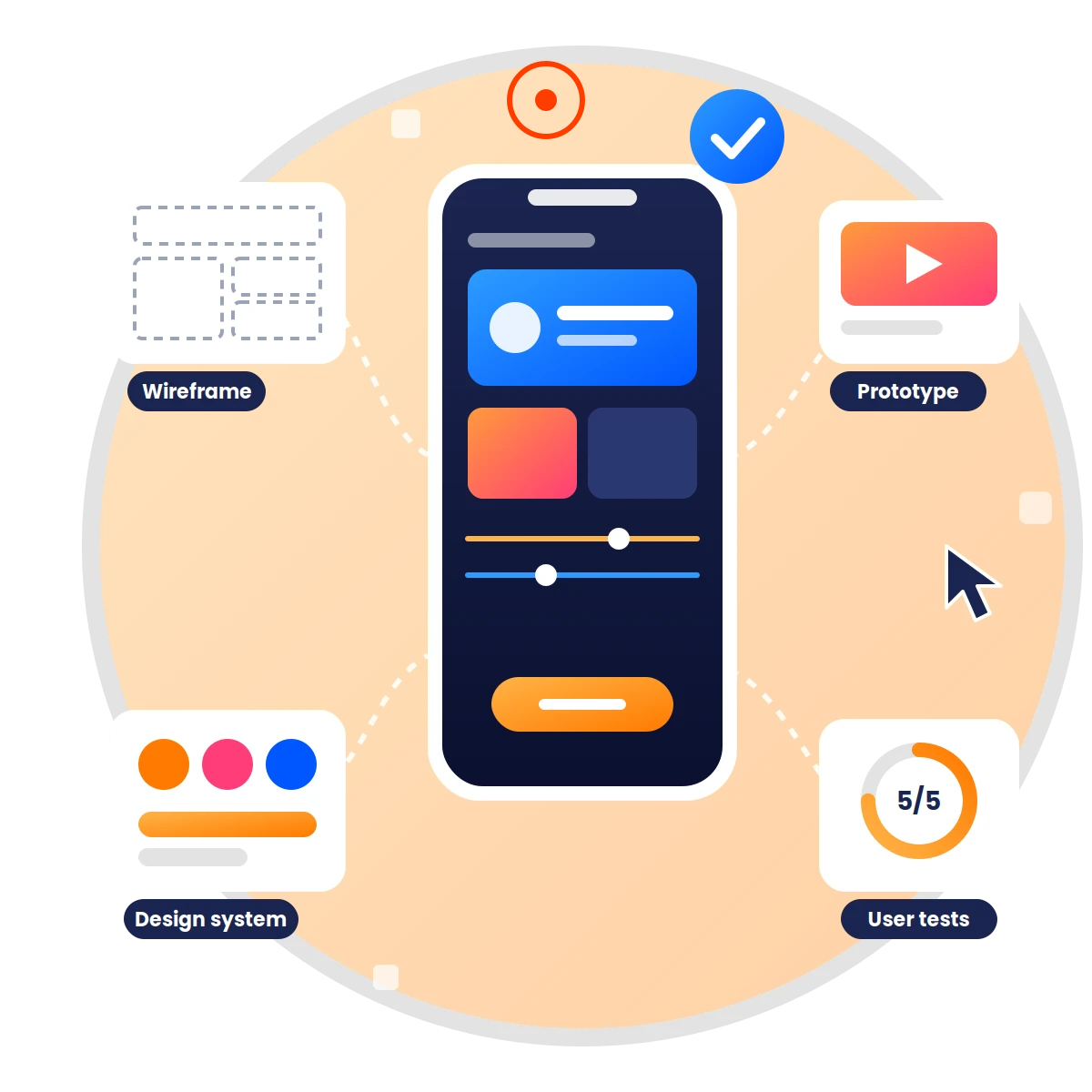
That is the work our product designers do. Before anyone writes code, we answer those questions with research, user flows, wireframes and a clickable prototype you can put in front of real users. From mobile apps and SaaS platforms to enterprise dashboards, you get a product direction you can explain to investors, stakeholders and your development team. Our UI/UX design services can also be booked on their own if you only need interface and experience work.
What is
Product design is the process of working out what a product should do, who it is for and how people will use it, then designing a solution that is useful, usable and commercially viable.
In digital products
In digital products, that includes research, product strategy, user flows, wireframes, UI design, prototyping, usability testing and handoff to development.
Understand users, market and goals.
Define vision, features and roadmap.
Map the journey and interactions.
Structure the layout and content.
Create a visual and brand experience.
Bring ideas to life and test early.
Validate with real users and iterate.
Deliver ready-to-build assets and specs.
Physical goods
The term is also used for physical goods, where it overlaps with industrial design, engineering and manufacturing.
Leelija focuses on digital product design: software products that people use on a screen.
Good product design is a business decision, not decoration. In McKinsey’s study of 300 publicly listed companies, firms in the top quartile of its Design Index achieved 32 percentage points higher revenue growth than industry peers over five years. Here is what that looks like for a single product:
Every design decision we make is tied to something we learned about your users or your business, not to personal taste.
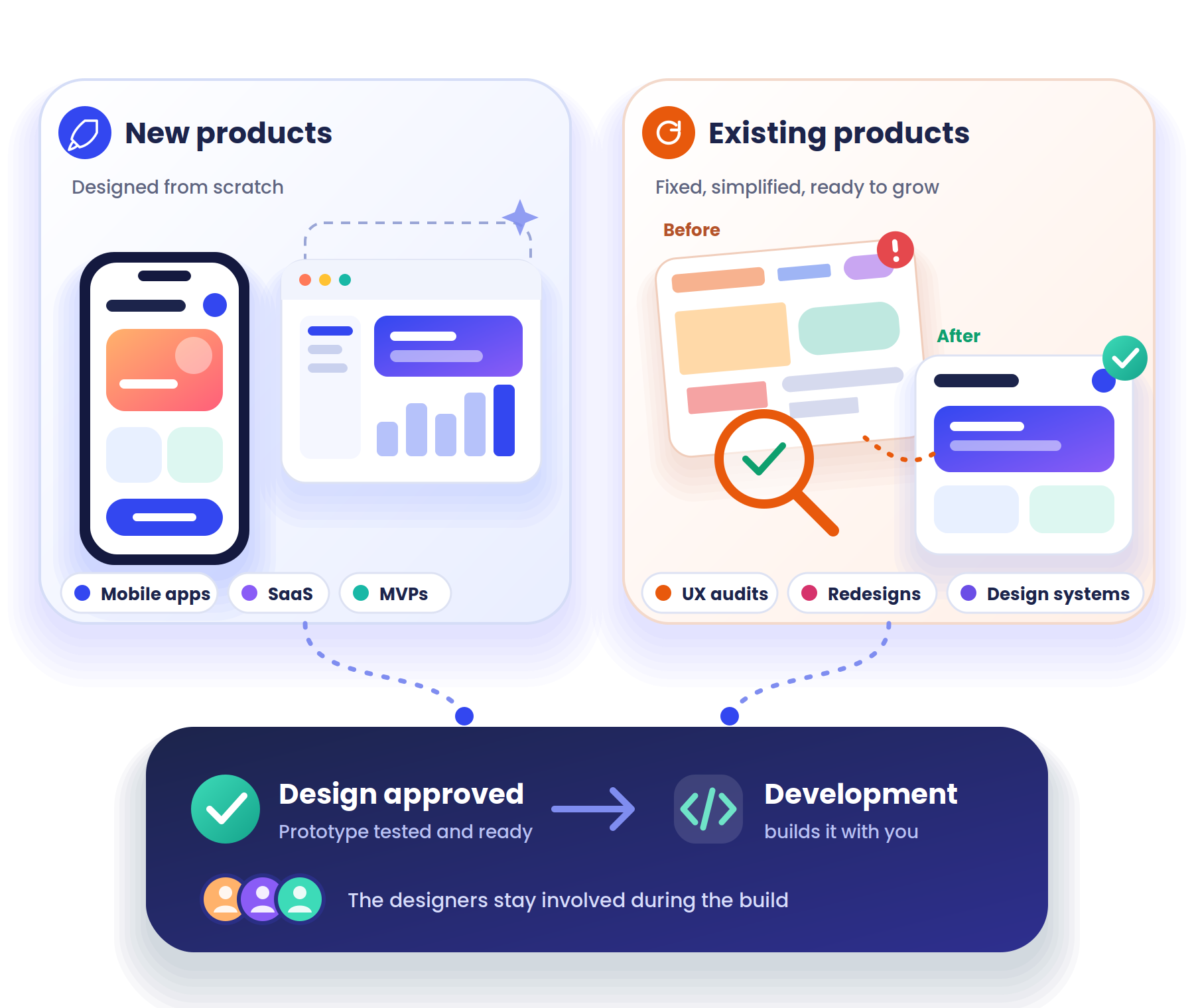
We design new products from scratch, and we fix existing ones that have become confusing, inconsistent or hard to extend.
Typical projects include:
Designed from scratch
Fixed and improved
When the design is approved, our Development services can build it, so the people who designed the product stay involved while it is built.
Every project ends with clear, usable files your team can build from, not just nice-looking screens.
Goals, target users, priority features, success metrics and constraints
Key findings, user personas, pain points and opportunities
How users move through every core task
Low-fidelity layouts for all key screens
High-fidelity Figma prototype of the core journeys
Final desktop and mobile screens, including empty, error and loading states
Colors, typography, components and usage rules
What was tested, where users struggled and what changed
Specifications, assets, annotations and interaction notes
Exact deliverables depend on scope. An early MVP, for example, may start with a lighter style guide and grow into a full design system later.
Here is how a typical project runs. Times are typical ranges and depend on scope.
We learn your idea, goals, users, market and constraints. For live products, we also review the current experience.
Output: Product brief
We study user needs and competitors, then prioritize features and core journeys.
Output: Research summary, feature priorities
We map how users move through the product and organize features and content.
Output: User flows, sitemap
We lay out key screens, focusing on structure and function, not decoration.
Output: Wireframes
We create the visual interface and apply your brand.
Output: High-fidelity screens
We link screens into a clickable prototype.
Output: Clickable prototype
We test with users, find friction and refine the design.
Output: Test report, revised designs
We prepare files and stay involved while your product is built.
Output: Handoff pack, design reviews
Total time depends on scope.
Focused MVP
6–10 weeks
One core product, a clear audience and a tight feature set.
Complex platform
10–16+ weeks
Several user roles, many journeys and deeper testing and handoff.
No single technique fits every product. These are the methods we choose from, depending on your product's stage and budget.
When we use it
To understand what users are really trying to get done, early in discovery.
When we use it
To learn from products that solve similar problems, including ones outside your industry.
When we use it
To see the full experience, including what happens before and after users touch the product.
When we use it
To check that navigation and menu labels make sense to users.
When we use it
To explore many ideas quickly before committing to one.
When we use it
To test ideas cheaply first, then refine the details.
When we use it
To find the biggest usability problems quickly and repeat after changes.
When we use it
To make the product usable for people with visual, motor or cognitive impairments.
When we use it
To keep a growing product consistent and faster to build.
When we use it
To improve live products based on real behavior after launch.
UI design, prototypes, design systems and developer handoff (Dev Mode)
Workshops, journey maps, user flows and brainstorming
Working with existing client files created in XD
Remote usability testing of prototypes
Heatmaps and session recordings on live products
Understanding user behavior before a redesign
Tracking design tasks alongside development
Speeding up research synthesis, content drafts and design exploration; every output is reviewed by our designers
Choosing a product design agency is not about finding someone who can make attractive screens. You need a team that understands your users, your business and what it takes to build the product.
We design products that our own developers then build, so our designs account for real technical limits, timelines and budgets.
Every flow, screen and interaction has a purpose based on what users need, not on visual trends.
We tie design choices to goals such as adoption, conversion, retention and operating efficiency.
Leelija designed and runs nidhisoft.com, a microfinance software platform. We know what happens after launch, because we live with our own products every day.
Our quality-managed processes mean clear documentation, defined milestones and consistent reviews.
You get shared Figma access, regular design reviews and clear progress updates, and you own the final design files.
Whether you hire Leelija or another team, these checks will help you avoid an expensive mismatch:
Ask for a case study that shows the problem, the process and the result.
Designing a data-heavy SaaS dashboard is different from designing a consumer app.
If the answer is “we follow best practice”, ask what they did on their last project.
Better still, ask to speak with a developer who has built from their files.
Including who owns the Figma source files.
How often you review work, and who your day-to-day contact is.
Not hourly rates alone.
Users should not need instructions for every action. We organize information, features and navigation so complex workflows feel easy to complete.
Consistent styles, components and interaction patterns help users learn a product once and feel at home on every new screen.
Clickable prototypes let you review flows and test with users before committing development budget.
Changing a wireframe takes hours; changing a built feature can take weeks. Finding problems early keeps budgets under control.
Every interaction shapes how customers see your brand. We keep the product consistent with your wider identity while putting usability first.
You may already have the idea and understand the problem you want to solve. Turning it into a product means answering harder questions: Who will use it? Which features matter first? How should people move through it? What should it look like? How will developers know exactly what to build?
That is where a digital product design agency earns its fee. At Leelija, we bring product thinking, UI/UX design, prototyping and development experience together to give you a clear path from concept to launch. If you need a wider website project, explore our Design and Development services and Web Design services.
Ready to turn your idea into a real product? Let’s design it together.
Endurix is a community-driven running club dedicated to helping runners of all levels train smarter, race harder and recover better.
A website design agency plans, designs and usually builds websites for businesses. The work covers research, sitemap and page planning, wireframes, visual design, responsive layouts for mobile and desktop, and conversion paths such as contact forms and calls to action. Full-service agencies like Leelija also develop, test and launch the website, and can support SEO and marketing after launch.
A professional website design project typically includes discovery, competitor review, a sitemap, wireframes for key pages, custom visual design, responsive layouts for desktop, tablet and mobile, interactive prototypes, and developer-ready design files. If development is included, you also get CMS setup, basic on-page SEO, speed optimization, cross-browser testing and launch support. Leelija lists every deliverable in the proposal before work starts.
Website builders are fine for simple sites, but they leave strategy, structure, speed and conversion planning to you. A professional web design agency brings researchers, designers, developers and SEO specialists together, so your site is planned around customers, built to load fast, and ready for search and advertising from launch. It also saves the time you would otherwise spend learning tools and fixing problems.
Aesthetics play a significant role in product design as they can influence a user’s perception of the product. A well-designed product that is visually appealing can enhance user satisfaction and increase the likelihood of adoption. However, aesthetics should be balanced with functionality and usability.
Look at their portfolio for businesses similar to yours, then ask four questions: how they plan a site before designing it, who builds it, how they handle SEO and page speed, and what happens after launch. Get the scope, number of revision rounds, timeline, price and file ownership in writing. Be cautious of agencies that show designs before asking about your customers, or that promise guaranteed rankings.
The cost depends mainly on the number of unique page layouts, custom features, content and copywriting needs, integrations, and whether development is included. A small business website with 5 to 10 pages costs far less than a corporate website with a CMS, multiple audiences and integrations..
A custom website costs more than a template-based site because the layouts, components and user journeys are designed for your business rather than adapted from a theme. In India, simple template-based sites can cost a few thousand rupees, while custom business, ecommerce and enterprise websites range from tens of thousands to several lakh rupees depending on scope. Leelija gives a fixed-scope quote after a short discovery call.
A small business website usually takes 4 to 6 weeks from kickoff to launch, and a corporate or B2B website 8 to 12 weeks. Ecommerce and enterprise sites can take 3 months or more. The biggest factors are the number of unique page types, how quickly content is ready, and how quickly feedback comes back.
Look at their portfolio for businesses similar to yours, then ask four questions: how they plan a site before designing it, who builds it, how they handle SEO and page speed, and what happens after launch. Get the scope, number of revision rounds, timeline, price and file ownership in writing. Be cautious of agencies that show designs before asking about your customers, or that promise guaranteed rankings.
A small business website usually takes 4 to 6 weeks from kickoff to launch, and a corporate or B2B website 8 to 12 weeks. Ecommerce and enterprise sites can take 3 months or more. The biggest factors are the number of unique page types, how quickly content is ready, and how quickly feedback comes back.
A template is a pre-made layout you adapt with your logo, colors and content. Custom website design starts from your goals, customers and content, and creates the layout and components around them. Templates are cheaper and faster for simple needs; custom design gives you a distinctive brand, better conversion paths and a structure that can grow without fighting a theme.
Most people now browse on phones, and Google uses the mobile version of a website to index and rank it. A responsive website adjusts its layout, text, images and buttons to every screen size, so visitors can read, navigate and contact you comfortably on any device. A site that is hard to use on mobile loses both rankings and enquiries.
A good business website tells visitors within seconds what you offer, who it is for and why they should trust you. It has clear navigation, fast loading, a mobile-friendly layout, real proof such as reviews and case studies, an obvious next step on every page, and a structure that search engines can crawl. It should also be easy for your team to update.
Redesign if your platform, content and URLs still work and the main problems are look, structure or usability. Build a new site if the platform is outdated or insecure, your business has changed a lot, or the site cannot support features you now need. A short audit of traffic, content and technology usually makes the right choice clear.
A redesign can be planned to protect rankings, but no honest agency can promise rankings will not move. We keep valuable URLs where possible, map 301 redirects for any URL that changes, carry over content, titles, meta descriptions and structured data, test on a staging site, and monitor Google Search Console after launch.
SEO-friendly website design means a site that search engines can easily crawl, understand and rank. That includes a logical page hierarchy, clean URLs, one H1 per page, internal links, fast loading, mobile-friendly layouts, image alt text and room for useful content. It gives SEO a strong foundation, but rankings also depend on content, links and ongoing optimization.
Conversion-focused web design arranges every page around the action you want visitors to take, such as calling, filling a form or buying. It uses clear headlines, proof near decision points, one main call to action per section, short forms and fewer distractions. Results are then measured with analytics and improved after launch.
Yes. We build on a content management system and train your team to edit text, images, blog posts and common page sections without a developer.
Your logo and brand assets if you have them, a short brief on your services and customers, examples of websites you like, access to your current website and domain, and the person who will approve designs. If you do not have website copy, we can plan it with you or write it.
We monitor the site after launch, fix any issues, and offer maintenance plans for updates, security, backups and speed checks. Yearly maintenance is excluded from the development price. Many clients also continue with SEO, paid advertising or content marketing through our digital marketing team.
Yes. Once the project is paid for, you own the website, its content and the final design files. Your domain and hosting stay in your name.
No. Any agency that guarantees rankings or lead numbers from design alone is overpromising. Good website design improves clarity, speed, usability and conversion paths, which gives SEO and advertising a much better base, but results also depend on competition, content, budget and ongoing marketing.