Native
How it works
Separate apps in Swift (iOS) and Kotlin (Android)
Performance
Best
Cost and time
Highest: two codebases
$ $ $Device features
Full and earliest access
Best for
Leelija provides end-to-end mobile app development services for startups, growing businesses and enterprises in the USA, UK, Europe, Australia, the UAE and India. We design, build, launch and maintain iOS, Android and cross-platform apps that people keep using, with the backend, integrations and admin tools that make them work.
We build and run our own software products too, including the FastBill billing app on Android. One team handles strategy, UI/UX, app and backend development, testing, App Store and Google Play launch, and updates after launch, from our development center in Kolkata, India.
A good app is not your website squeezed onto a phone. It does a few important jobs quickly: booking, ordering, paying, tracking, checking an account, or getting work done away from a desk. And it has to keep working as Apple and Google change their rules every year.
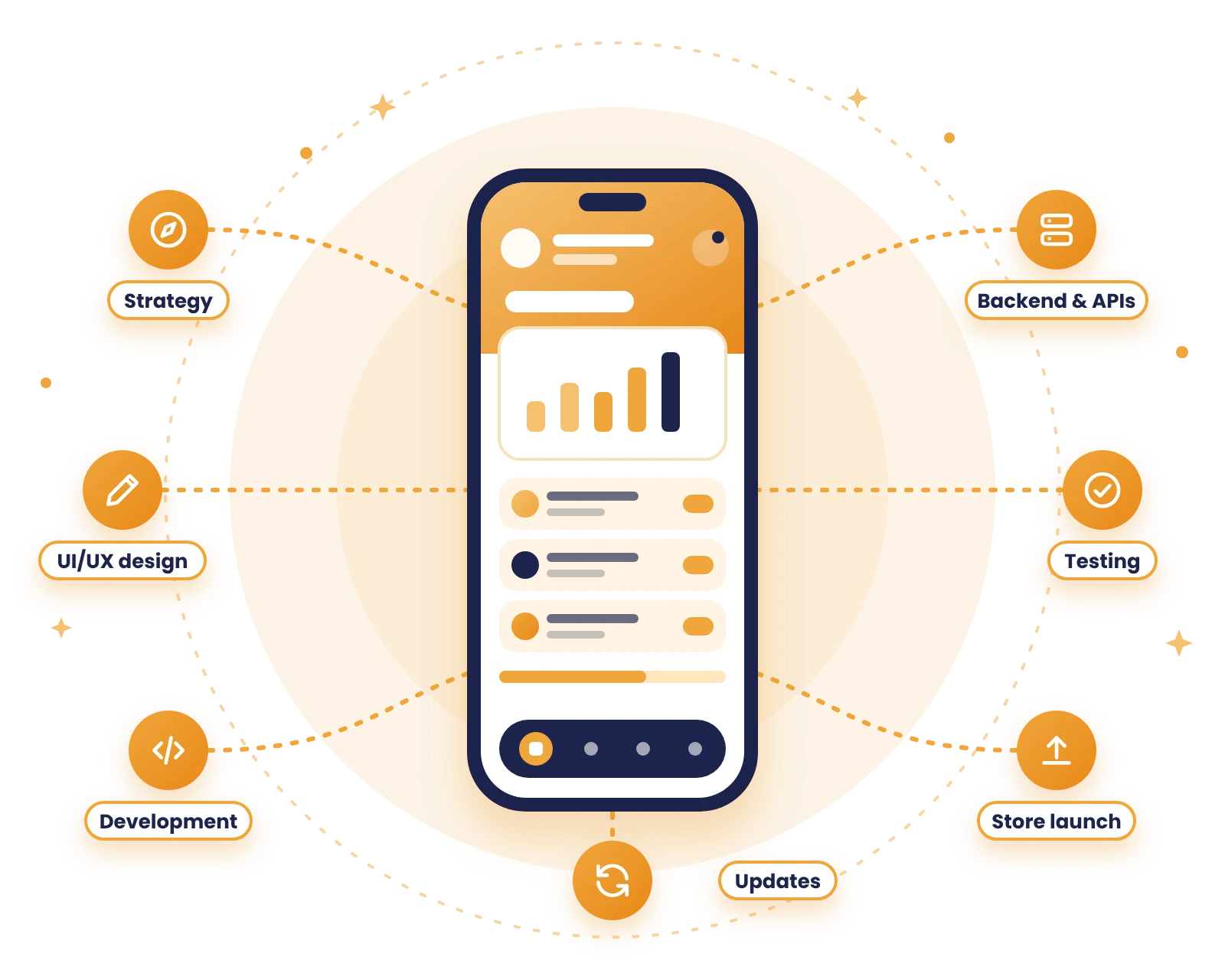
As a mobile app development agency, we start by understanding your users, your business model and the systems the app must connect to. Then we recommend the right platform and technology, design the experience, and build the app and its backend in two-week sprints you can test on your own phone. Our UI/UX design team designs the screens, and our product development team helps when the app is a new product you plan to sell.
Mobile app development services (also called mobile application development services) cover everything needed to plan, design, build, launch and maintain an app for smartphones and tablets: strategy, UI/UX design, iOS, Android or cross-platform development, backend and APIs, testing, App Store and Google Play publishing, and ongoing updates. A full-service mobile application development company handles all of these with one team.
How it works
Separate apps in Swift (iOS) and Kotlin (Android)
Performance
Best
Cost and time
Highest: two codebases
$ $ $Device features
Full and earliest access
Best for
How it works
One codebase for both, using Flutter or React Native
Performance
Near-native for most business apps
Cost and time
Lower: one codebase for both platforms
$ $ $Device features
Most features, plus native modules when needed
Best for
How it works
A web app wrapped in an app shell, or installed from the browser
Performance
Fine for simple, content-led apps
Cost and time
Lowest
$ $ $Device features
Limited
Best for
The right first platform depends on where your users are. Open a country to see the share of mobile users on each platform, from StatCounter (September 2026).
Business apps aimed at professionals often see a higher iPhone share than these national averages, so we also look at your own website analytics before deciding.
Select your country or region
Whether you need new product development services for an idea or help with a product that is already live, each stage calls for a different plan:
Confidence that the problem is real and the product is feasible
Discovery sprint, proof of concept, product roadmap
Something users and investors can see and try
Clickable prototype, then MVP development
Stability, better onboarding, the features paying users ask for
Product engineering, analytics, SaaS features, performance work
More capacity and a team that knows the code
Dedicated product development team
Modern technology, better UX, lower maintenance cost
Product modernization in stages
Our digital product development services cover every stage, from the first workshop to scaling a live product. You can start with any one of them.
Our product discovery services turn an idea into a testable plan. In one to two weeks we define target users, the problem, competitors, the riskiest assumptions, must-have features and technical feasibility, and finish with a scope, estimate and recommended next step. Product development consulting is also available on its own for teams that need an outside view.
We turn priorities into a release roadmap: what goes into the MVP, what follows in versions 1.1 and 2.0, which metrics decide what comes next, and what the dependencies are. The roadmap changes as you learn from users.
When the biggest risk is technical, such as an unusual integration, AI feature or performance requirement, we build a small proof of concept first, so you do not fund a full build on an untested assumption.
Clickable Figma prototypes of the key journeys, which you can test with users and show to investors before development starts.
Our MVP development services deliver the smallest version of your product that real users can use and pay for, typically in 8 to 14 weeks. Minimum viable product development is about learning fast without cutting corners: the MVP is built on clean architecture so it can grow into the full product without a rewrite. Founders choose us as their MVP development company because the same team can carry the product beyond launch.
We build SaaS products with multi-tenant architecture, sign-up and onboarding, team accounts and roles, subscription billing, admin dashboards, usage analytics and integrations. As a SaaS product development company, we have also built and run our own SaaS product, FastBill, so we plan for the realities of billing, support and uptime from the start.
Marketplaces, B2B platforms, booking products, fintech tools and industry-specific software designed around what makes your product different, not a template.
Fast, responsive web products with React or Next.js frontends, secure backends, databases and APIs. For internal business tools rather than market products, see custom web development.
iOS and Android apps built with React Native or Flutter, sharing one backend with your web product, including notifications, offline use and app store submission.
Architecture, frontend and backend engineering, API design, automated testing, CI/CD and monitoring that keep the product reliable and easy to change as requirements grow.
Products designed for AWS or other cloud platforms, with containers, managed databases, automated deployment, monitoring and auto-scaling, sized for your real traffic so cloud bills stay sensible.
AI features that add real value to your product, such as assistants trained on your content, smart search, document data extraction, recommendations and automated summaries, built with privacy and cost controls.
Public APIs for your customers, and integrations with payment providers such as Stripe, PayPal and Razorpay, CRMs such as HubSpot and Salesforce, accounting tools such as QuickBooks, Xero and Tally, messaging, maps and analytics services.
Functional, regression, cross-browser, device, performance and security testing, with automated tests for critical journeys so every release is safe to ship.
Production setup, monitoring and alerts, app store submission, phased rollouts, launch-day support and handover documentation.
Framework upgrades, architecture refactoring, cloud migration, performance fixes and UX redesign for existing products, delivered in stages without disrupting customers.
Bug fixes, security patches, dependency upgrades, uptime monitoring and a steady flow of new features under a monthly plan.
Not every SaaS feature belongs in version one. We prioritize the essentials for launch, then add advanced capabilities as your product and customer base grow.
Start with the core features
Add them as you grow
Build the foundation your first users need.
Help new users register, explore your product and reach value quickly.
Let companies invite colleagues and assign the right permissions.
Keep each customer’s data isolated with secure tenant access controls.
Collect recurring revenue with providers such as Stripe, Razorpay and PayPal.
Manage customers, subscription plans, accounts and support operations.
Understand user behavior and identify the features that drive retention.
Confirm important actions and bring users back with timely updates.
Expand capabilities as customer needs evolve.
Charge customers based on usage, seats, transactions or other pricing metrics.
Connect your product with customer systems and third-party applications.
Support enterprise identity management, access policies and activity tracking.
Customize the experience for different brands, markets and languages.
Let's prioritize the features your users need now and plan the right capabilities for future growth.
Most agencies only build software for others. We also build, sell and support our own products, so we know what happens after launch day.
SaaS Billing and Stock Management
Our GST billing and stock management software for small businesses and enterprises. It creates GST invoices with taxes calculated automatically and keeps billing, stock and payments in one place.
Microfinance Software
Software for microfinance and Nidhi companies that manages loans, savings, branches, agents and collections, with the right access for every level of the organisation.
What you receive
What you receive
What you receive
What you receive
What you receive
What you receive
What you receive
What you receive
We choose the stack based on your features, existing systems, expected traffic and who will maintain the code later, not on what is fashionable.
When we use them: Interactive dashboards, portals and SEO-friendly public pages
When we use them: Business logic, APIs, background jobs and integrations
When we use them: Structured business data, reporting and caching
When we use them: Hosting, deployments, automation and uptime monitoring
When we use them: Online payments, subscriptions and invoicing
When we use them: Tracking user behaviour, conversions and product usage
When we use them: Chat assistants, content automation and smart search
We build against the OWASP Top 10 (2025), starting with broken access control and security misconfiguration:
Main law
DPDP Act 2023 and DPDP Rules 2025
Built into your product
Consent notices and withdrawal, breach procedures
Main law
CCPA/CPRA (California) and other state privacy laws
Built into your product
Privacy controls, data access and deletion requests
Main law
UK GDPR and EU GDPR
Built into your product
Consent, data minimization, regional data hosting
Main law
Privacy Act 1988
Built into your product
Collection notices, access and correction requests
Main law
Federal PDPL (Decree-Law 45 of 2021); DIFC and ADGM rules
Built into your product
Consent capture, cross-border transfer controls
We also build to WCAG 2.2 Level AA accessibility, which supports the ADA in the USA and the European Accessibility Act in the EU. Your legal adviser confirms the specific obligations for your product.
Modular code, a well-designed database, caching and cloud infrastructure that can add capacity as users grow.
We plan for the growth you expect over the next two to three years, so you are not paying for a million-user system on day one.
Our engineers use AI coding assistants for repetitive work such as boilerplate code, test cases and documentation, which shortens delivery time.
public function store(Request $request)
{
$data = $request->validate([
'client_id' => 'required|exists:clients,id',
'amount' => 'required|numeric|min:0',
]);
}
Every line is reviewed by a developer.
Your code and data are not shared with public AI tools without your permission.
Our engineers stay accountable for quality and security.
Step 01
We map users, the problem, competitors, risks and must-have features.
Typical time
1–2 weeks
Output
Product brief, estimate
Step 02
We test key assumptions and choose a proof of concept, prototype or MVP.
Typical time
About 1 week
Output
MVP scope, roadmap
Step 03
We design flows and screens and test a clickable prototype.
Typical time
2–3 weeks
Output
Approved prototype
Step 04
We choose the stack and design the data model, APIs and cloud setup.
Typical time
About 1 week
Output
Technical plan
Step 05
We build in two-week sprints and demo working software each sprint.
Typical time
4–8 weeks for an MVP
Output
Working product
Step 06
We test features, devices, performance and security.
Typical time
Throughout, plus 1 week
Output
Test reports
Step 07
We deploy, monitor and support the release.
Typical time
About 1 week
Output
Live product
Step 08
We review analytics and feedback and plan the next release.
Typical time
Ongoing
Output
Updated roadmap
Step 09
We add features, capacity and team members as the product grows.
Typical time
Ongoing
Output
Maintenance plan
How it works
Fixed-price sprint ending with a scope, roadmap and estimate
Best for
How it works
Agreed features, price and timeline, paid by milestone
Best for
How it works
Product manager, designer, developers and QA working only on your product, billed monthly
Best for
How it works
We act as your complete product and engineering team while you own the product decisions
Best for
Our team works from Kolkata, India (IST, UTC+5:30). Here is how our day lines up with yours:
Live overlap with our team
Your full business day
How we work together
Same-day calls and fast replies
Live overlap with our team
Your morning to mid-afternoon
How we work together
Daily stand-ups in your morning
Live overlap with our team
Your afternoon
How we work together
Calls in your afternoon; progress ready each morning
Live overlap with our team
Your early morning or our evening, by appointment
How we work together
Daily written updates and weekly demos; work continues while you sleep
Live overlap with our team
Full business day
How we work together
Calls, visits and workshops in Kolkata
A dedicated English-speaking product manager, sprint demos every two weeks over Zoom, Google Meet or Microsoft Teams
Shared Slack or Teams channel and a Jira board, so you can see progress any time
NDA before we start, and a contract that assigns all intellectual property to you
Code in your own Git repository and hosting in your own cloud account, in your region if needed
Invoices in USD, GBP, EUR, AUD, AED or INR, payable by bank transfer, Wise or PayPal
Milestone-based payments, so you only pay for work you have approved
Thefastbill and Nidhisoft give us first-hand experience of launching, selling, supporting and scaling software, not just building it.
We start with users, the problem and success metrics, and we will tell you when a feature is not worth building yet.
Product designers and engineers plan together, so what is designed can be built on time and on budget.
Discovery, MVP, scaling or modernization: the engagement matches where your product is today.
Source code, IP, designs, cloud and app store accounts are yours. No lock-in.
Working hours that overlap yours, contracts that protect you, and rates well below local agencies in the USA, UK, Europe and Australia.
Documented processes, code reviews and quality checks on every release.
Which products have you launched, and can I speak with one of those clients?
How do you decide what goes into the MVP?
How often will I see working software?
Who will actually work on my product, and will that team stay the same?
How do you handle security, privacy and quality?
Who owns the code, IP and accounts, and what happens if I move to another team?
What does support and growth look like after launch?
Red flags: a fixed price before anyone asks about your users, no discovery phase, no demos until the end, code kept on the agency’s own accounts, and a team that builds everything on your list without questioning any of it.
Have a SaaS idea, a platform concept or a product that needs a stronger next version?
Tell us:
We will recommend the right first step, whether that is a discovery sprint, a prototype, an MVP or a dedicated team, with a clear scope, timeline and price.
Talk to Our Product Development TeamWe recommend the right first step for you
Related services
Leelija Web Solutions Pvt. Ltd. is led by Safikul Islam, CEO. We are based in Barasat, Kolkata, India, and work with clients in the USA, UK, Europe, Australia, the UAE and India.
Endurix is a community-driven running club dedicated to helping runners of all levels train smarter, race harder and recover better.
Mobile app development services cover everything from idea to app store and beyond: discovery and app consulting, feature planning, mobile UI/UX design and prototyping, iOS, Android or cross-platform development, backend and API development, testing on real devices, App Store and Google Play submission, and maintenance after launch. At Leelija, every proposal lists the exact deliverables before work starts.
A simple app starts from about US$5,000, a cross-platform MVP from about US$8,000, a mid-complexity app from about US$15,000 and a complex or enterprise app from about US$30,000, with separate rupee pricing for clients in India. The main cost drivers are the number of screens and features, one or two platforms, backend and integrations, and design complexity. Because our team is based in India, clients in the USA, UK, Europe, Australia and the UAE usually pay well below local agency rates. We provide a project-specific estimate after understanding your requirements. [CONFIRM prices]
An Android-only app usually costs less than building for both platforms. With Leelija, a simple Android app starts from about US$5,000 (₹1,50,000 in India), and a feature-rich Android app with a backend, payments and admin panel typically starts from about US$12,000. Add the Google Play developer registration fee of US$25 (one time). [CONFIRM prices]
A simple app or focused MVP usually takes 8 to 12 weeks, a mid-complexity app 3 to 5 months, and a complex or enterprise app 5 to 8 months or more, often released in phases. Add a few days for App Store and Google Play review. The biggest factors are scope, integrations, how fast feedback comes back, and whether you build one platform or two. [CONFIRM]
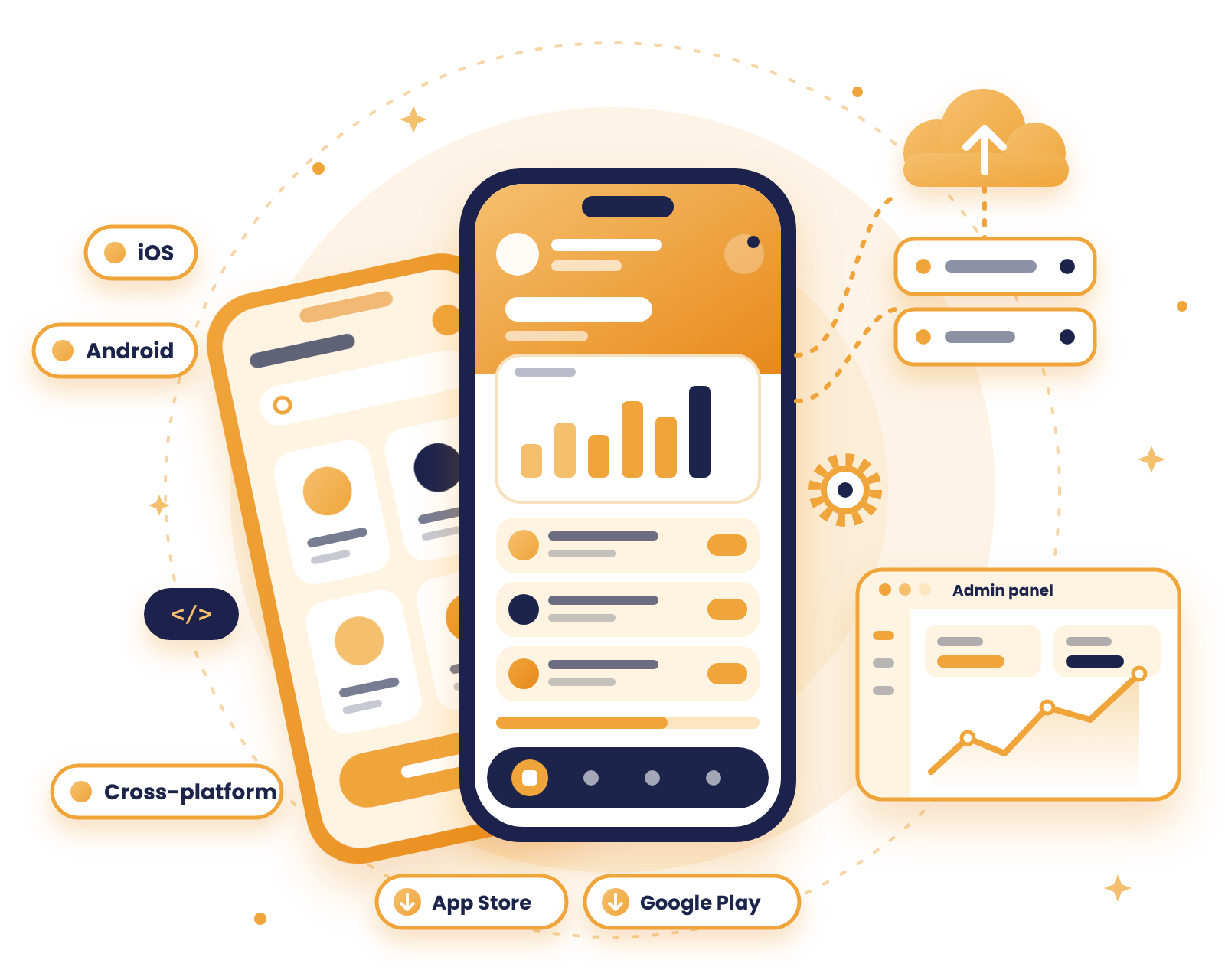
Native apps are built separately for each platform, using Swift for iOS and Kotlin for Android, which gives the best performance and earliest access to new device features. Cross-platform apps use one shared codebase, with Flutter or React Native, to run on both iOS and Android, which usually cuts development and maintenance cost. For most business apps, cross-platform is the better value; native makes sense for heavy graphics, advanced hardware use or platform-specific features.
Neither is better for every app. Flutter, from Google, uses the Dart language and draws its own interface, which makes custom designs look identical on both platforms. React Native, from Meta, uses JavaScript or TypeScript and native components, which suits teams already using React for their website. We recommend one after discovery based on your design, features, integrations and who will maintain the app. [CONFIRM frameworks you use]
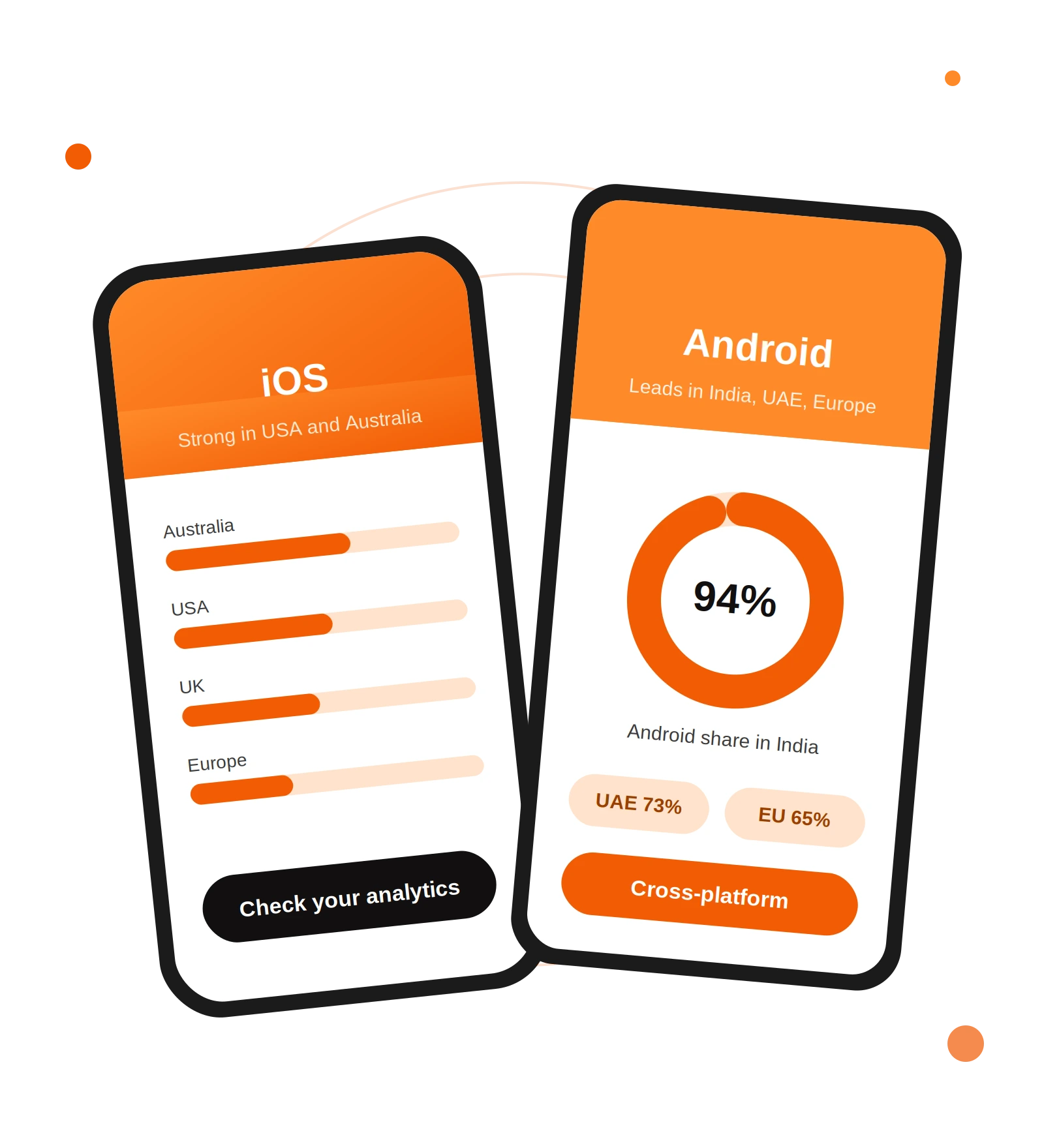
Follow your customers. In September 2026, iOS had about 54% of mobile users in the USA and 63% in Australia, while Android had about 94% in India and 73% in the UAE (StatCounter). If your users are spread across markets, or you are in the UK or Europe where both platforms are large, a cross-platform app reaches both at once for little extra cost.
Download and try apps the company has actually published, ask to speak with a past client, and check how they handle design, testing on real devices, app store submission and updates after launch. Make sure the contract gives you the source code and publishes the app under your own developer accounts. Be cautious of very low quotes with no discovery, and of teams that cannot explain native versus cross-platform trade-offs.
You can hire a fixed-scope team for a defined app, or hire dedicated mobile app developers monthly to work on your product. Prepare a short brief with your audience, platforms, key features and integrations, then interview the team, review published apps and start with a small paid discovery phase to test how you work together. Leelija offers both models. [CONFIRM]
Start with the one problem your app solves and the shortest journey that solves it. Design a clickable prototype and test it with a few target users, then build only the essential features, usually as a cross-platform app so you reach iOS and Android together. Launch with analytics and crash reporting, learn from real usage, and plan the next release around what users actually do.
Budget roughly 15 to 20% of the original development cost per year, a common industry rule of thumb. That covers updates for new iOS and Android versions, security patches, bug fixes, library upgrades, server costs and small improvements. App store rules also change every year; for example, Google Play now requires apps to target Android 16, and Apple requires the iOS 26 SDK for new uploads. [CONFIRM Leelija maintenance plans]
Yes. We build cross-platform apps that run on both iOS and Android from one codebase, and native apps when a project needs them. Our own product, FastBill, runs as an Android app alongside its web version. [CONFIRM iOS and native capability]
Yes. We prepare store listings, screenshots, privacy labels and builds, and handle submission and review responses. Apps are published under your own Apple and Google developer accounts so you stay in control. Approval is decided by Apple and Google, but we build to their guidelines from the start to avoid rejections.
Yes. Apps usually share a backend and APIs with your website, and we connect them to CRMs such as HubSpot and Salesforce, accounting tools such as QuickBooks, Xero and Tally, payment gateways such as Stripe, PayPal and Razorpay, and maps, messaging and analytics services.
Yes. Enterprise apps typically include secure login with single sign-on, role-based access, offline mode for field teams, approvals, reporting and integration with internal systems, and are distributed through the app stores or privately through your device-management system.
Yes. We review the code, libraries, design and store compliance, then update the app for the latest iOS and Android requirements, fix performance and crash issues, redesign key screens or rebuild it in stages on a cross-platform framework.
We build against the OWASP Mobile Top 10 risks: secure login and token handling, encrypted data in transit and on the device, protected API keys, permission checks on the server, safe third-party libraries and security testing before release. We also complete Apple’s privacy labels and Google Play’s Data safety form accurately and design data handling for laws such as GDPR, CCPA and India’s DPDP Act.
Yes, with the right safeguards. We sign an NDA before you share details, assign all intellectual property to you, keep code in your own Git repository, publish under your own developer accounts and bill by approved milestone. Our ISO 9001:2015 certified processes add documented quality checks.
You do. The contract assigns all intellectual property to you, and the source code, designs, backend, cloud accounts and App Store and Google Play accounts are in your name. [CONFIRM ownership terms]
We monitor crashes, reviews and analytics, fix issues quickly and keep the app compatible with new iOS and Android versions. Most clients continue with a maintenance plan and regular feature releases, and our digital marketing team can help with app store optimization and user acquisition.